
From Sinners to Backrooms: How Horror Took Over Hollywood and Won’t Let Go
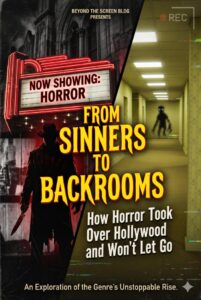
I used to think horror was the runt of Hollywood’s litter — cheap, disposable, something studios greenlit to fill a slow October weekend. Then Ryan Coogler walked into a 1932 Mississippi juke joint, brought Michael B. Jordan back from the dead (twice), and made the most talked-about film of 2025. I sat in an IMAX theater watching Sinners and felt something shift. Not just in me — in the entire room. Horror had stopped playing defense. It was winning.
And now, barely a year later, a 20-year-old YouTuber named Kane Parsons has directed an A24 psychological horror film about liminal space — Backrooms — that grossed over $262 million globally on a budget of under $10 million. The genre isn’t a trend. It’s a takeover.
The Numbers Don’t Lie: Horror’s Box Office Dominance in 2025–2026
Let me throw some figures at you, because they’re genuinely staggering.
Through August 2025, horror films accounted for nearly 15% of total box office revenue — generating over $843 million. That’s up from a 9.8% domestic ticket share in 2024 to 12.1% by mid-2025. And the trajectory since then has only sharpened.
Horror ranked fifth by total gross in 2025 but generated $16 million per film — four times what drama produced and thirty-three times what documentaries earned per release. Think about that efficiency. No other genre comes close on a per-film basis.
The Conjuring: Last Rites grossed $400 million globally by the end of 2025, becoming the year’s highest-grossing horror film. But Sinners and Weapons held the distinction of being the highest-grossing original horror films not based on pre-existing IP — a significant achievement in a franchise-obsessed industry.
When I saw these numbers laid out, I stopped being surprised that studios were racing into the genre. I started being surprised it took them this long.
Sinners: The Film That Proved Horror Could Be Prestige Cinema
I’ll be blunt — I didn’t expect Sinners to wreck me emotionally. I came in expecting vampires and blues music. I left thinking about generational trauma, the terror of being Black in Jim Crow America, and whether music can literally save your soul.
Ryan Coogler’s Sinners is a genre-defying hybrid of Southern Gothic, gangster film, supernatural horror, and musical elements — set in 1932 Mississippi Delta, with Michael B. Jordan playing criminal twin brothers confronting a supernatural evil.
What made it extraordinary wasn’t the horror mechanics. It was the storytelling foundation beneath them. The film spends roughly half of its 2-hour, 17-minute runtime establishing its characters and their relationships before any vampires appear — and even before the supernatural elements kick in, the Mississippi Delta setting generates its own dread: petty thieves, racist violence, and the ever-present threat of the Jim Crow South.
The result was something critics almost never say about a horror film: it was the best movie of the year.
Sinners earned a 97% critic score and 96% audience score on Rotten Tomatoes and a worldwide gross of $366.7 million — with Oscar buzz to match.
Audiences polled by CinemaScore gave it an “A” grade — the highest for any horror film in 35 years.
Sitting in that theater, I watched something happen that I don’t think I’d ever seen with a horror movie before: people were moved. Not just startled — moved. The woman beside me was crying during a scene I can only describe as a jazz-blues time-travel sequence. That doesn’t happen with jump-scare horror. That’s prestige cinema wearing a monster’s mask.
Why Horror Works: The Psychology of Fear as Entertainment
I’ve spent a lot of time thinking about why horror has such a grip on us right now — and I think the answer is more interesting than “people like to be scared.”
Horror has undergone a fundamental shift toward psychological storytelling that carries a social message — what critics call “elevated horror.” These thematically dense films particularly connect with Gen Z viewers, a generation that deeply values social justice and diversity. Over 90% of Gen Z consumers watched horror movies or TV shows as of 2024 — the highest share among all age groups.
That stat hit me personally. I’m part of that demographic. And when I think about why horror resonates with people my age, I think it’s because the real world already feels like a horror movie. Economic uncertainty, surveillance states, pandemic aftershocks, political collapse. Elevated horror gives us a container for that anxiety. It lets us process dread in the dark, safely.
Horror connects with primal emotions and offers favorable economics in the US market — appealing through both original stories and established franchises. But more than economics, it offers something therapy can’t always provide: a shared, cathartic experience of surviving something terrifying, together, in a room full of strangers.
That’s why horror is a communal art form in a way that other genres struggle to match. Nobody talks about a Marvel film in the bathroom afterward. After Sinners, I stood in the lobby for twenty minutes just listening to strangers debate what happened.
The Backrooms: When Internet Horror Grows Up
If Sinners proved horror could go prestige, Backrooms proved it could go viral-to-theatrical and win.
The origin story here matters. In 2022, a teenage filmmaker named Kane Parsons uploaded a found-footage horror short called The Backrooms to YouTube, and it exploded across the internet — turning the eerie maze of empty yellow-lit rooms into a viral phenomenon within weeks.
A24 took notice, acquiring the rights and giving Parsons, still only in high school, the chance to expand his creation into a feature film. The Backrooms concept originated in a 2019 online thread — a single image of a barren room in yellow fluorescent light, accompanied by the premise that you could accidentally “no-clip” out of reality and find yourself trapped forever in a sprawl of rooms with unseen entities stalking the corridors.
The feature film hit theaters on May 29, 2026. I watched it feeling like I was in a fever dream — and I mean that as the highest compliment.
Critics highlighted Parsons’ skill at creating dread through mood, sound design, and eerie visuals rather than conventional jump scares — drawing comparisons to Eraserhead, The Shining, and Skinamarink based on the film’s dreamlike horror and use of empty spaces.
As of mid-June 2026, Backrooms had grossed $160 million domestically and over $262 million globally — on a production budget of under $10 million.
What stunned me most wasn’t the film itself — it was what it represented. The box-office success of Backrooms alongside other films like Obsession was cited by industry analysts as evidence of the growing influence of YouTube-born filmmakers in the horror genre. The pipeline to Hollywood now runs through your bedroom and a Blender 3D tutorial. That’s genuinely new.
The Internet-to-Cinema Pipeline: Creepypasta, YouTube, and the New Horror Mythology
Backrooms isn’t an isolated case. It’s part of a broader structural shift in how horror mythology gets created and distributed.
In 2026, a string of hits — particularly Backrooms and Obsession — have cemented horror as the genre of the moment and a wildly profitable one. Obsession was made on just $1 million by Blumhouse and made over $290 million globally.
The economics are almost absurd. A $1 million film returning $290 million is not a fluke — it’s a business model. And horror is uniquely positioned for it because the genre’s raw material is emotion, not spectacle. You don’t need $200 million in CGI to terrify someone. You need stillness, sound design, and an image that lodges in the back of their skull.
Social media engagement around psychological horror analysis content has grown 43% year-over-year, with the 25-to-34 demographic — college-educated, high-spending — driving demand for deep-dive content. This signals a shift from passive consumption to active participation: audiences aren’t just watching horror, they’re dissecting it.
I experienced this firsthand after Backrooms. Within hours, Reddit was full of frame-by-frame analyses of the entities in the background. TikTok had people walking through the lore. YouTube had essays going up before I’d even processed what I’d watched. Horror is interactive now in a way action or drama rarely is. It invites obsession.
What This Means for Hollywood’s Future
Here’s the thing studios are quietly realizing: horror is the last genre that can do everything.
It can be prestige (Sinners). It can be viral (Backrooms). It can be franchise (The Conjuring). It can be micro-budget (Obsession). It can win Oscars (The Substance, Nosferatu nominations in 2024). It can break IMAX records. IMAX accounted for nearly 20% of Sinners‘ domestic opening weekend — a staggering premium-format performance for a genre historically associated with multiplexes.
Horror’s market share grew 3.7 times over the past decade — from 2.69% to 9.84% — making it the only genre besides action to consistently gain share year over year.
The horror pipeline for 2026–2028 is the deepest on record. Major studios have committed to franchise extensions, legacy IP reboots, and auteur-driven originals simultaneously — a sign that horror is now treated as a core business line, not a seasonal allocation.
That last point is the one that stays with me. Horror used to be seasonal — October filler. Now it runs year-round. Sinners opened in April. Backrooms launched at the end of May. Horror doesn’t need Halloween anymore. It is Halloween, all year long.